01 / The business rule
A report that looks right.
A monthly report can add up correctly and still use the wrong date boundary. Start with what the report is supposed to mean.
A practical field guide · C. Shane Rivers
A compact operating manual for developers who already use coding agents and want repeatable, reviewable work.
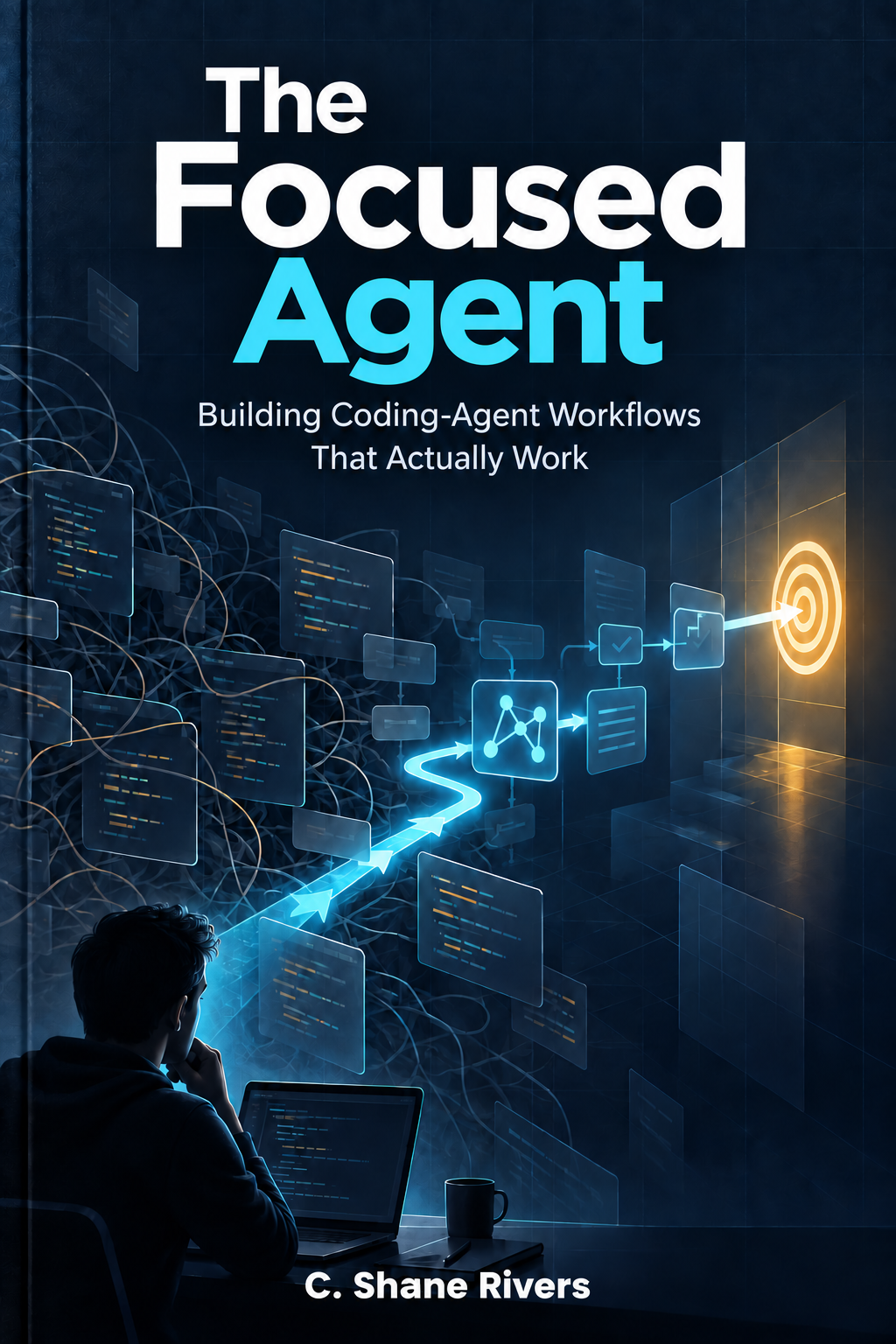
The Focused Agent
Building Coding-Agent Workflows That Actually Work
“Done” needs a little more detail.
The FOCUS method
A change can look good and still miss the business rule. A helpful cleanup can turn a small assignment into a large review. FOCUS gives you a way to keep the job clear from the first brief to the final decision.
Say what needs to change—and what done means.
Give it the project context the task actually needs.
Set the boundaries before the work starts.
Give each role a job it can finish and hand back.
Keep the checks, the results, and the human decision.
Start with your next task
Ten editable forms, a printable handbook, and a completed example showing how the records fit together. Start with a small task and keep the evidence.
Download the toolkitZIP · Editable Markdown, PDF, and a JavaScript teaching example
No signup required. Author-review edition.
In the companion kit
Use the parts the work needs. You don’t need ten forms for every task.
Inside the book
Three case studies follow the work through its decisions, limits, and handoffs. Recorded, reconstructed, and illustrative material are labeled for what they are.
01 / The business rule
A monthly report can add up correctly and still use the wrong date boundary. Start with what the report is supposed to mean.
02 / The scope boundary
Keep the discovery in a follow-up ledger. Give it a next step without turning the current assignment into a cleanup campaign.
03 / The handoff
Separate planning, implementation, testing, and review. Keep each handoff bounded and the human approval visible.
Also inside: a recorded publishing-workflow specimen, a permission ladder, project-memory guidance, and a thirty-day plan for putting the method to work.

About the author
I’m a full-stack developer and the founder of Aerovisus Business Solutions in Leeds, Alabama. My twenty-five-year technology career has included support, business applications, laboratory software, enterprise insurance services, and independent development.
I wrote The Focused Agent for developers, technical founders, consultants, and small teams dealing with coding agents in real work. A confident summary can leave out the test that never ran. I want the working record to make that visible.
Aerovisus Business SolutionsFrom Shane
Follow along as I prepare The Focused Agent and its companion materials. I’ll share book news, new examples, and useful additions to the toolkit.